How Many Batteries Do You Need for Home Backup?
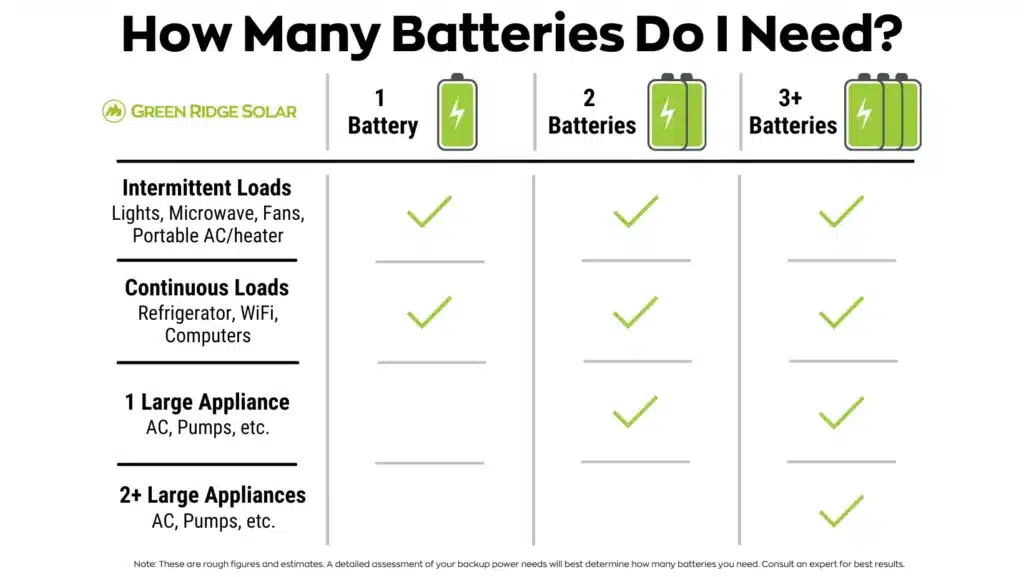
The number of batteries needed for home backup can range from a relatively small setup to a large whole-home system. The answer depends on what the batteries must accomplish. A household keeping a few key functions running has a different target from one expecting air conditioning, cooking, refrigeration, lighting, and everyday outlets to remain available together. Battery count also depends on the design of the system itself. Instead of choosing a number first, define three things: the desired coverage, the electrical demand at one time, and the backup period you want.

Define What One Battery Setup Must Accomplish
Count Household Functions Before Counting Batteries
Start with the experience you want during an outage. One household may want refrigeration, internet, several lights, and phone charging. Another may want the home to operate much closer to its regular routine, including central air conditioning and other major appliances. Make a list by household function rather than walking around recording every plug. Group electricity into cooling or heating, food storage, communications, lighting, cooking, work, entertainment, and other relevant categories. Then decide which categories should remain fully available. This creates a clear specification for a battery backup for home. The eventual battery count becomes the result of that specification rather than an arbitrary number selected before the home’s requirements are understood.
Measure How Much Happens at the Same Time
Capacity alone cannot determine how many battery units a home needs. The system must also supply the power required when several appliances operate together. Consider an evening when the refrigerator is cycling, lights are on, someone is cooking, electronics are running, and the climate system starts. That moment may place a very different demand on the backup system than the quiet hours after midnight. Large motor-driven equipment also has startup requirements that deserve separate attention. Anker SOLIX E10 illustrates this distinction clearly. One E10 provides 7.6 kW continuous output and 10 kW turbo output for up to 90 minutes, while up to 37.2 kW of surge power can start a 5-ton central A/C.
Choose the Household Experience You Want to Preserve
Backup sizing becomes more intuitive when it is described as a level of normality. Ask what family members should be able to do without reorganizing their day around the outage. If several people work from home, daytime electricity may carry greater importance. A household with electric cooking may place more emphasis on meal periods. Homes in climates with substantial cooling demand may treat central A/C as part of the expected backup experience. This perspective also reveals why two houses with similar floor areas can need different configurations. Occupancy, appliance choices, schedules, and comfort expectations shape electrical demand. The number of batteries should therefore reflect how the household actually lives, not simply the number of bedrooms or square footage.
Match Battery Count to the Scale of Backup
Separate the Number of System Units From Storage Capacity
“Number of batteries” can be misleading because one system unit may support different amounts of battery capacity. With Anker SOLIX E10, capacity can range from 6 kWh to 30 kWh per E10 unit, while three E10 units with Power Dock can reach 90 kWh. This means storage sizing has two dimensions: how many E10 units the system uses and how much battery capacity is configured with them. A household might need additional stored energy because it wants a longer backup period, while another might focus on system output because many loads need to run simultaneously. Looking at these dimensions separately produces a more precise configuration than treating every additional battery as if it changes the system in exactly the same way.
Scale Power and Storage Together for Larger Homes
As backup expectations grow, power capability and storage capacity can rise together. Three E10 units provide up to 22.8 kW of continuous output and 30 kW of turbo output, alongside a maximum configured storage capacity of 90 kWh with Power Dock. The 200A Power Dock is designed for whole-home panel backup, which makes the configuration relevant when the goal extends beyond a small set of circuits. For homes with substantial climate-control requirements, two E10 units can provide up to 66 kW of surge power for simultaneous startup of 5-ton and 3-ton central A/C systems. These figures show why battery count should be tied to a defined electrical objective: additional system scale can address both stored energy and the power available to run the home.

Include Recharging Before Finalizing the Number
A home does not necessarily have to rely only on the electricity stored at the instant an outage begins. Recharging changes how much initial capacity may be useful for a given backup plan. Each E10 supports up to 9 kW of solar input through dual 30V–450V MPPTs, while three units with Power Dock can reach 27 kW. With CT, E10 can also work with an existing solar system. A 4.5 kW Smart Generator provides another charging route. When sizing a system, consider how stored capacity and replenishment will work together across the intended backup period. The appropriate configuration is therefore based on an energy system—storage, output, household demand, and available charging sources—rather than battery quantity viewed in isolation.
Conclusion
There is no universal number of batteries that fits every home. Start by defining which household functions should continue, how much equipment may operate simultaneously, and how closely the home should follow its normal routine during an outage. Then match those expectations with both storage capacity and system output. Finally, include solar or other available charging sources in the plan. This method turns “How many batteries?” into a more useful sizing decision based on the home’s actual electrical behavior, desired backup experience, and plans for future energy use.