

A Clear, Fact-Based Guide for Homeowners, Property Managers, and Safety Professionals
You don’t see it.
You don’t smell it.
You definitely don’t want to breathe it.
Asbestlint conditions develop quietly, often in older buildings where asbestos-containing materials (ACMs) age, break down, or get disturbed. Many property owners assume that asbestos only becomes dangerous during demolition. That’s not always true.
Over time, tiny asbestos fibers can separate from materials and mix with dust-like debris — a condition often described in industry discussions as “asbestlint.” It refers to fine asbestos-containing dust that settles in indoor environments after deterioration or disturbance.
This article explains:
- What Asbestlint conditions really mean
- How they develop
- What triggers fiber release
- Why aging buildings increase the risk
- How to prevent exposure
- What trusted authorities say about it
All information in this article is based on established guidance from organizations such as:
- World Health Organization (WHO)
- U.S. Environmental Protection Agency (EPA)
- Occupational Safety and Health Administration (OSHA)
- Centers for Disease Control and Prevention (CDC)
- National Institute for Occupational Safety and Health (NIOSH)
No fear-based exaggeration. No random statistics. Just verified, practical information.
What Are Asbestlint Conditions?
“Asbestlint” is not an official medical diagnosis. It’s a practical way to describe a situation where:
- Asbestos-containing materials deteriorate
- Fibers release into air
- Fibers mix with indoor dust
- Fine debris settles on surfaces
According to the EPA, asbestos becomes hazardous when materials are damaged, disturbed, or friable (easily crumbled by hand pressure). When that happens, microscopic fibers enter the air and remain suspended for long periods.
You cannot see individual asbestos fibers with the naked eye. That’s why these conditions often develop unnoticed.
WHO confirms that there is no safe level of asbestos exposure. Even low-level exposure over time increases the risk of diseases such as:
- Asbestosis
- Lung cancer
- Mesothelioma
So yes — tiny fibers matter.
Where Asbestos Is Commonly Found
Understanding how Asbestlint conditions develop starts with knowing where asbestos exists.
According to the EPA and CDC, asbestos was widely used in:
- Pipe insulation
- Boiler insulation
- Ceiling tiles
- Vinyl floor tiles (especially 9×9 inch tiles)
- Roofing shingles
- Cement siding
- Textured coatings and fireproofing sprays
Buildings constructed before the 1980s have a higher probability of containing asbestos materials.
The material itself is not automatically dangerous. Problems start when the material degrades or someone disturbs it.
The Science: How Asbestlint Conditions Develop
Let’s break this down logically.
Asbestlint conditions don’t appear overnight. They develop step-by-step.
1. Material Aging
Asbestos-containing materials age just like everything else.
- Insulation dries out
- Adhesives weaken
- Tiles crack
- Binding materials deteriorate
When the matrix holding asbestos fibers breaks down, fibers become easier to release.
EPA defines friable asbestos as material that can be crumbled by hand pressure. Friable materials release fibers more easily than non-friable materials.
Aging increases friability.
2. Physical Disturbance
Disturbance is the biggest trigger.
Common causes include:
- Renovation work
- Drilling or cutting walls
- Removing old flooring
- HVAC maintenance
- Vibration from heavy machinery
- Water damage cleanup
OSHA clearly states that mechanical disturbance releases airborne asbestos fibers.
Even small activities like sanding textured surfaces can create significant fiber release.
You don’t need demolition to create risk. Sometimes a simple DIY project does the job.
3. Air Movement and Circulation
Once fibers release, air movement spreads them.
- HVAC systems circulate fibers
- Fans redistribute particles
- Foot traffic resuspends settled dust
NIOSH confirms that asbestos fibers can remain airborne for hours depending on airflow conditions.
Over time, fibers settle on:
- Carpets
- Furniture
- Ducts
- Clothing
This is where “asbestlint” conditions become more persistent.
4. Repeated Low-Level Disturbance
Here’s the tricky part.
You might not notice one single event. But repeated small disturbances compound the issue:
- Opening ceiling panels
- Minor repairs
- Regular vibration
- Deteriorating pipe insulation
Each small release adds more fibers to the indoor dust reservoir.
Over months or years, this can create ongoing exposure risk.
Environmental Factors That Accelerate Development
Certain conditions speed up fiber release.
Moisture and Water Damage
Water weakens binding agents.
After flooding or leaks:
- Insulation softens
- Ceiling tiles sag
- Adhesives fail
EPA warns that water-damaged asbestos materials often require professional assessment.
Temperature Fluctuations
Thermal expansion and contraction cause cracking.
Over decades, heating and cooling cycles:
- Create micro-fractures
- Loosen surface coatings
- Increase brittleness
These micro-damages allow fiber shedding.
Mechanical Vibration
Buildings near:
- Industrial sites
- Rail lines
- Heavy traffic
experience constant vibration.
Vibration contributes to gradual material breakdown.
It sounds boring, but physics never sleeps.
Why Older Buildings Face Higher Risk
WHO and CDC data confirm that most asbestos use occurred before strict regulations in the 1980s and 1990s.
Older buildings often have:
- Aging insulation
- Outdated HVAC systems
- Deferred maintenance
- Renovation history
Each factor increases the chance of disturbance.
If multiple renovations happened without proper asbestos surveys, fiber contamination may already exist in dust layers.
This doesn’t mean every old building is dangerous. It means age increases probability.
The Health Link: Why Fiber Release Matters
Let’s stay fact-based.
According to WHO:
- All types of asbestos cause cancer.
- Mesothelioma strongly links to asbestos exposure.
- No safe exposure threshold exists.
CDC explains that disease develops after inhalation of airborne fibers. The body cannot easily break down or remove them.
Health risks depend on:
- Intensity of exposure
- Duration
- Fiber concentration
- Individual susceptibility
Symptoms usually appear decades after exposure.
That long latency period often hides the connection.
Signs That Asbestlint Conditions May Be Developing
You cannot confirm asbestos presence without lab testing. But certain signs increase suspicion:
- Crumbling pipe insulation
- Powdery debris near insulation
- Cracked ceiling tiles
- Dust buildup after maintenance
- Visible deterioration of old materials
If the building predates the 1980s, caution increases.
The EPA recommends professional inspection before renovation in older properties.
What Happens During Renovation Without Controls
Here’s a common scenario.
Someone renovates a pre-1980 building without testing.
They:
- Remove floor tiles
- Break drywall
- Disturb ceiling panels
Dust spreads everywhere.
Without containment:
- Fibers travel through HVAC
- Workers carry fibers on clothing
- Dust settles in adjacent rooms
OSHA requires employers to assess asbestos presence before disturbance.
Skipping that step creates ideal conditions for widespread fiber distribution.
That’s how asbestlint-like contamination spreads through entire indoor environments.
Secondary Contamination: The Hidden Layer
NIOSH documents cases where workers carried fibers home on clothing.
This is called take-home exposure.
Similarly, within buildings:
- Maintenance rooms contaminate hallways
- Ductwork spreads fibers
- Cleaning without HEPA filtration redistributes particles
Regular vacuum cleaners do not capture microscopic asbestos fibers effectively.
Only HEPA-rated systems designed for hazardous dust reduce spread.
Improper cleaning can worsen the problem.
Yes, even cleaning can make it worse if done incorrectly.
How Professionals Prevent Asbestlint Conditions
Licensed asbestos professionals follow strict protocols guided by OSHA and EPA regulations.
They use:
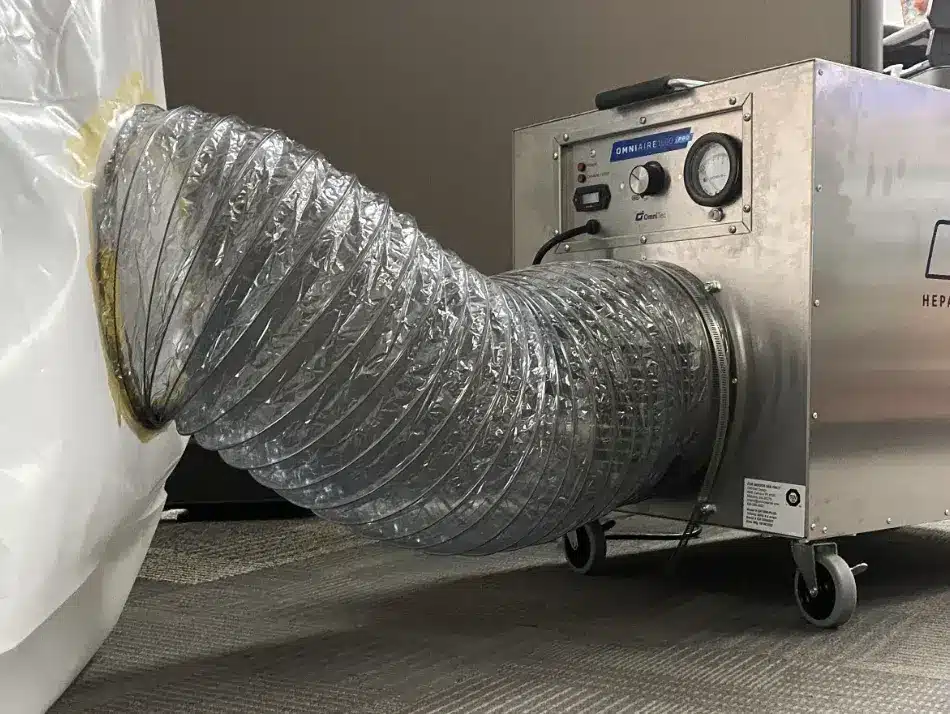
- Containment barriers
- Negative air pressure systems
- HEPA filtration
- Wet methods to suppress dust
- Air monitoring
Wet methods reduce airborne fiber release significantly, according to OSHA guidance.
Air sampling confirms whether fiber levels remain below regulatory limits.
Professional controls prevent the development of long-term contamination conditions.
The Role of Air Monitoring
Air monitoring plays a critical role in identifying fiber presence.
According to OSHA standards:
- Phase Contrast Microscopy (PCM) measures fiber concentration.
- Transmission Electron Microscopy (TEM) provides more detailed analysis.
Monitoring confirms whether control measures work.
Without testing, you guess.
With testing, you know.
Guesswork does not protect health.
How to Reduce Risk in Older Properties
If you manage or own an older building, focus on prevention.
1. Do Not Disturb Suspect Materials
If materials remain intact, leave them undisturbed.
EPA confirms that intact asbestos materials generally pose lower risk.
2. Conduct an Asbestos Survey Before Renovation
Hire certified inspectors before any demolition or remodeling.
This step prevents accidental fiber release.
3. Maintain Materials Properly
Seal minor damage with approved encapsulation methods.
Encapsulation prevents fiber escape without full removal.
4. Train Maintenance Staff
OSHA requires asbestos awareness training in certain workplaces.
Staff should recognize suspect materials before drilling or cutting.
5. Use Proper Cleaning Equipment
If contamination exists, use HEPA filtration systems.
Never dry sweep suspect dust.
Myths About Asbestlint Development
Let’s clear up common misconceptions.
Myth 1: Asbestos only becomes dangerous during demolition.
False. Minor disturbance can release fibers.
Myth 2: If you can’t see fibers, there is no risk.
False. Fibers are microscopic.
Myth 3: Old asbestos is harmless because it’s “sealed.”
False. Aging increases friability.
Myth 4: Regular cleaning solves the problem.
False. Standard vacuums do not capture microscopic fibers effectively.
Facts matter more than comfort.
Legal and Regulatory Framework
Several regulations guide asbestos management:
- OSHA Asbestos Standards (29 CFR 1910.1001 & 1926.1101)
- EPA Asbestos Hazard Emergency Response Act (AHERA)
- Clean Air Act regulations
These rules require:
- Proper identification
- Worker protection
- Controlled removal
- Waste disposal procedures
Compliance reduces the development of contamination conditions.
Ignoring regulations increases both health and legal risks.
Why Early Action Protects Trust and Health
If you run a property or facility, your credibility depends on safety.
Proactive asbestos management shows:
- Responsibility
- Transparency
- Compliance
- Professionalism
Tenants and employees trust organizations that follow science and regulations.
Delaying action increases both exposure and liability.
Smart management always beats emergency cleanup.
Conclusion
Asbestlint conditions develop gradually through:
- Aging materials
- Physical disturbance
- Air circulation
- Repeated minor releases
- Improper cleaning
They don’t appear magically. They follow predictable patterns.
Trusted authorities like WHO, EPA, OSHA, CDC, and NIOSH consistently confirm:
- Fiber release causes risk
- No safe exposure level exists
- Prevention works
If materials remain intact, risk stays lower.
If materials deteriorate or get disturbed, risk increases.
The solution is not panic.
The solution is awareness, inspection, and controlled management.
Science supports that approach. Regulations support that approach. Health depends on that approach.