Asbestos Siding: What Homeowners Need to Know (Without the Panic)
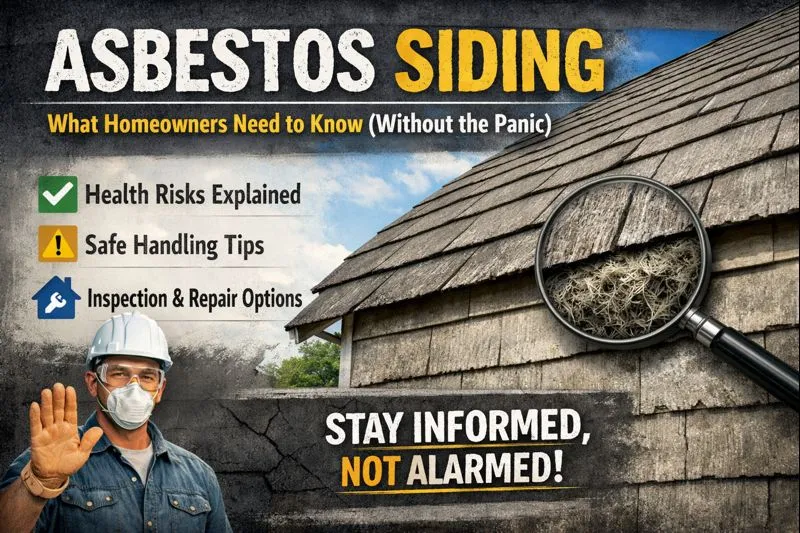
Asbestos siding sounds scary. The word alone can make homeowners imagine hazmat suits, six-figure removal bills, and neighbors whispering behind hedges.
Take a breath.
Asbestos siding is not automatically dangerous, and it does not mean your home is unsafe. Millions of homes still have it. Many stand strong after 60 –100 years.
This guide explains asbestos siding clearly, honestly, and without fear tactics. We’ll cover what it is, why builders used it, real risks, and smart homeowner decisions based on verified sources, not internet myths.
Let’s get into it.
What Is Asbestos Siding?
Asbestos siding is a cement-based exterior cladding that contains asbestos fibers. Builders widely used it in North America from the 1920s through the late 1970s.
Manufacturers mixed asbestos with cement to create siding that was:
- Fire-resistant
- Insect-proof
- Weather-resistant
- Long-lasting
From a construction standpoint, it was a brilliant idea.
From a health standpoint? That’s where context matters.
Fact check: According to the U.S. Environmental Protection Agency (EPA), asbestos becomes a health risk only when fibers become airborne and are inhaled.
Solid, undisturbed siding does not release fibers.
Why Builders Loved Asbestos Siding
Builders didn’t use asbestos to be reckless. They used it because it solved real problems.
Key Reasons for Its Popularity
- Fire resistance (a big deal before modern fire codes)
- Durability (many panels last 75+ years)
- Low maintenance
- Affordability
- Resistance to rot and termites
In the mid-20th century, asbestos siding felt like a superhero in panel form.
Ironically, many homes with asbestos siding have outlasted vinyl replacements installed decades later.
How to Identify Asbestos Siding (Without Guessing)
You cannot confirm asbestos siding just by looking. Still, some clues help narrow it down.
Common Visual Signs
- Installed before 1980
- Shingle-style or rectangular panels
- Brittle texture (chips rather than bends)
- Looks like cement, not wood or vinyl
- Often gray, green, or pastel-painted
But here’s the rule that matters:
Only lab testing can confirm asbestos.
The EPA and CDC both recommend professional sampling instead of DIY breaking or drilling.
Breaking siding to “check” is like shaking a soda bottle to see if it’s fizzy. Bad idea.
Is Asbestos Siding Dangerous?
Short answer: Not when left alone.
Long answer: It depends on condition and handling.
When Asbestos Siding Is Low Risk
- Panels are intact
- Paint is stable
- No cutting, drilling, or sanding
- No storm damage
According to the CDC and NIOSH, asbestos exposure risk increases only when fibers become airborne.
Solid cement siding does not release fibers on its own.
When Asbestos Siding Becomes a Problem
Problems arise during disturbance, not existence.
High-Risk Situations
- Power washing with high pressure
- Cutting panels for windows or vents
- Breaking damaged shingles
- DIY removal
- Renovation without containment
This is why many asbestos issues start during home improvement projects, not daily living.
Should You Remove Asbestos Siding?
This is where logic beats panic.
Removal Is NOT Always Required
The EPA explicitly states that asbestos materials in good condition are often best left in place.
Removal creates exposure risk. Leaving intact siding alone does not.
Removal Makes Sense If:
- Panels are severely damaged
- You’re doing major exterior renovations
- Local regulations require it
- You plan to sell and buyers demand removal
Otherwise, encapsulation or maintenance often works better.
Encapsulation: The Smarter Alternative
Encapsulation means sealing asbestos siding, not removing it.
Common Encapsulation Methods
- High-quality exterior paint
- Specialized elastomeric coatings
- Installing new siding over existing panels (where permitted)
This approach:
- Prevents fiber release
- Costs less than removal
- Preserves siding integrity
- Aligns with EPA recommendations
Think of it as putting asbestos in a protective bubble, not poking it with a stick.
Can You Paint Asbestos Siding?
Yes and it’s often encouraged.
Best Practices (According to EPA Guidance)
- Do not scrape or sand
- Use low-pressure washing
- Repair cracks carefully
- Apply high-quality exterior paint
- Avoid drilling or nailing
Paint locks fibers in place. Peeling paint is the real enemy.
Cost Comparison: Removal vs. Encapsulation
Exact costs vary by location, home size, and regulations. Still, the pattern stays consistent.
Typical Cost Reality
- Professional removal: High cost, strict disposal rules
- Encapsulation: Significantly lower cost
- Overlay siding: Mid-range, often practical
According to multiple state environmental agencies, removal often costs several times more than encapsulation for similar surface areas.
More money does not always mean more safety.
Selling a Home With Asbestos Siding
Yes, people sell homes with asbestos siding every day.
What Matters to Buyers
- Condition
- Disclosure
- Documentation
- Professional inspections
Many buyers care more about roof age and foundation health than siding material.
Transparency builds trust. Panic kills deals.
Legal and Safety Regulations (Brief but Important)
Rules vary by country, state, and city.
Still, most regulations agree on three points:
- DIY removal is discouraged
- Licensed contractors are required
- Proper disposal is mandatory
Always check local environmental or health department guidelines before starting any project.
Myths About Asbestos Siding (Let’s Kill Them)
❌ “Asbestos siding poisons the air”
No. Undisturbed siding does not release fibers.
❌ “You must remove it immediately”
False. The EPA says removal is often unnecessary.
❌ “Painting makes it worse”
Wrong. Proper painting reduces risk.
❌ “All asbestos siding is crumbling”
Many panels remain structurally sound after decades.
Fear spreads faster than facts. Stick with facts.
Trusted Sources Used in This Article
To maintain accuracy and trust, this article aligns with guidance from:
- U.S. Environmental Protection Agency (EPA)
- Centers for Disease Control and Prevention (CDC)
- National Institute for Occupational Safety and Health (NIOSH)
- State environmental health departments
These organizations provide ongoing, peer-reviewed asbestos safety guidance.
Final Thoughts: Calm, Informed Decisions Win
Asbestos siding is not a ticking time bomb. It’s a legacy building material that needs respect, not fear.
If it’s intact, leave it alone.
If it needs work, follow professional guidance.
If removal makes sense, do it safely and legally.
The smartest homeowners don’t panic.
They learn, verify, and act with logic.
And that’s exactly how Google—and your users prefer it.