Asbestos Drywall Joint Compound: Risks, Identification & Safe Handling

Asbestos drywall joint compound remains one of the most overlooked hazards in older buildings, yet it continues to affect contractors, inspectors, renovators, and property owners every year. Widely used for decades because of its fire-resistant and strengthening properties, asbestos was blended into drywall joint compound, texture coatings, and wall finishes until health risks became undeniable.
Today, disturbing old joint compound during cutting, sanding, drilling, or demolition is one of the most common ways asbestos fibers become airborne. According to World Health Organization, over 125 million people worldwide remain exposed to asbestos in workplaces and buildings, and more than 107,000 deaths occur globally each year from asbestos-related diseases.
This professional guide explains exactly where asbestos appears in drywall systems, how dangerous it really is, how to test safely, and what regulations apply—so you can protect lives, remain compliant, and avoid costly litigation.
You forget what you want to remember, and you remember what you want to forget. It’s the possibility of having a dream come true that makes life interesting. It is not in the stars to hold our destiny but in ourselves.
Asbestos in Drywall
Is there asbestos in drywall?
Yes—in older buildings, asbestos is most commonly found in drywall joint compound, not the drywall sheet itself. Joint compound was used to:
- Embed paper tape
- Fill screw holes
- Skim-coat entire walls and ceilings
- Create textured finishes
If your building was constructed or renovated between the 1930s and early 1980s, asbestos drywall joint compound is a legitimate concern.
Which drywall components contain asbestos?
Asbestos was rarely added directly to the gypsum board. Instead, it was found in:
- Joint compound (primary source)
- Textured ceiling coatings (popcorn, stipple, swirl)
- Skim coats over plaster or drywall
- Some adhesives and undercoats
The highest fiber release risk comes from dry sanding and cutting of joint compound during renovation.
Does drywall have asbestos today?
Modern drywall and finishing products do not contain asbestos. Manufacturing standards changed after the late 1970s, and consumer bans eliminated asbestos from patching compounds by 1977 under the U.S. Consumer Product Safety Commission. By the mid-1980s, asbestos-free joint compounds became the industry standard.
When was asbestos drywall used?
Asbestos drywall joint compound was commonly used from:
- 1930s → Late 1970s (peak use)
- Small residual use into early 1980s
Any structure built or remodeled before 1985 should be treated as suspect until tested.
What does asbestos drywall look like?
There is no reliable visual indicator. Many people search:
- “what does asbestos drywall look like inside”
- “asbestos drywall pictures”
Unfortunately, asbestos joint compound:
- Looks identical to non-asbestos compound
- Can be smooth, lumpy, white, gray, or tan
- May appear brittle with age—but this is not diagnostic
Only laboratory testing can confirm asbestos content.
Is drywall the only wall and ceiling component that contains asbestos?
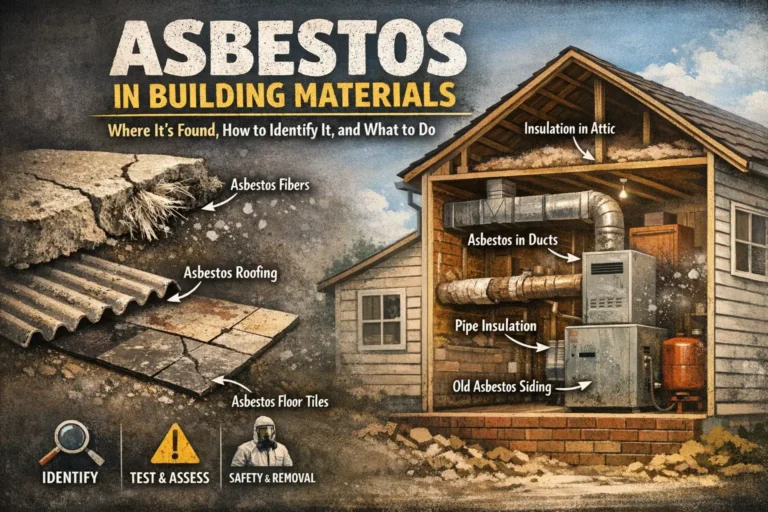
No. Asbestos was used extensively throughout interior construction materials, including:
- Plaster
- Ceiling tiles
- Spray-on fireproofing
- Pipe insulation
- Flooring mastics
- Acoustic panels
- Boiler insulation
From a risk-management standpoint, drywall joint compound should never be evaluated in isolation.
What should I do if I live or work in an older building with asbestos drywall?
Commercial Buildings with Asbestos Drywall
Commercial properties face strict liability and regulatory oversight. Best practices include:
- Commissioning a licensed asbestos survey before any remodeling
- Maintaining asbestos management plans
- Registering unavoidable ACMs with local authorities (where required)
- Ensuring negative-air containment systems during abatement
- Performing post-abatement air clearance testing
Failure to comply can result in:
- Heavy fines
- Project shutdowns
- Civil lawsuits
- Long-term workers’ compensation claims
Residences with Asbestos Drywall
Homeowners face a different legal threshold but equal health risk:
- Assume asbestos if the home predates 1985
- Avoid sanding, drilling, or cutting drywall
- Never dry-scrape popcorn ceilings
- Test before installing wiring, plumbing, or new HVAC systems
While homeowners are sometimes exempt from formal licensing rules, unsafe DIY asbestos disturbance can still expose:
- Family members
- Neighbors
- Waste-handling workers
What occupations have been impacted by asbestos drywall?
Historically affected jobs include:
- Drywall installers and tapers
- Carpenters and general laborers
- Plumbers and electricians
- HVAC technicians
- Building inspectors
- Demolition crews
- Renovation contractors
Studies indexed by National Institutes of Health confirm that repeated low-level exposure during routine sanding and cutting has caused mesothelioma and asbestosis decades later, even in short-term renovation workers.
Latency periods range from 20 to 50 years, meaning workers exposed in the 1980s may only now be showing symptoms.
10 Things to Know About Asbestos in Drywall
1. What is Asbestos?
Asbestos is a group of six naturally occurring fibrous minerals valued for:
- Heat resistance
- Tensile strength
- Chemical stability
When inhaled, its microscopic fibers embed in lung tissue and cannot be expelled.
2. How Common is Asbestos in Drywall?
- Up to 70% of pre-1980 drywall joint compounds tested in North America have been found to contain asbestos.
- Some products contained 3–6% asbestos by weight—more than enough to create hazardous airborne fiber levels during sanding.
3. Why is Asbestos so Prevalent?
For decades it was:
- Cheap
- Durable
- Fire-resistant
- Crack-resistant
Manufacturers had no legal obligation to disclose health risks prior to the 1970s.
4. How Dangerous is Asbestos in Drywall?
Asbestos drywall joint compound becomes dangerous when:
- Sanded
- Drilled
- Cut
- Demolished
These actions release friable fibers directly into the breathing zone.
5. What are the Health Risks?
Medical conditions linked to asbestos exposure include:
- Mesothelioma (pleural & peritoneal)
- Lung cancer
- Asbestosis
- Pleural thickening
- Chronic obstructive pulmonary disease
The Centers for Disease Control and Prevention confirms no safe exposure threshold exists.
6. What Layer of the Wall is Asbestos In?
Primarily:
- Joint compound at seams
- Skim coats
- Textured finishes
Rarely:
- Certain imported gypsum boards
- Plaster underlayment layers
7. When Should I Have My Walls Tested?
Test before:
- Bathroom or kitchen remodels
- Electrical rewiring
- Wall demolition
- HVAC duct installation
- Window or door enlargement
8. How is Asbestos Tested?
Testing uses:
- Polarized Light Microscopy (PLM)
- Transmission Electron Microscopy (TEM) for ultra-fine fibers
DIY asbestos drywall test kits exist but still require laboratory analysis and proper containment to avoid self-exposure.
9. Who Takes Asbestos Samples?
- Licensed asbestos inspectors
- Certified industrial hygienists
- Environmental testing firms
Unauthorized sampling in commercial settings is illegal in many jurisdictions.
10. Are ACMs Still Used in Construction?
No—intentional use is largely banned. But:
- Old materials remain in circulation
- Imported products occasionally violate regulations
- Renovations continue to expose hidden ACMs
What To Do if Your Drywall Contains Asbestos
If confirmed:
- Stop all work immediately
- Isolate the area with plastic sheeting & negative pressure
- Use only HEPA-filtered vacuums
- Prevent fiber tracking through ventilation systems
- Dispose of waste at licensed hazardous waste landfills
- Conduct post-removal air clearance sampling
Never use:
- Household vacuums
- Dry sweeping
- Compressed air
- Standard dust masks
When is Asbestos in Residential Drywall Not Regulated?
In many regions:
- Intact asbestos in private homes is not regulated until disturbed
- Once renovation begins, full asbestos laws apply
- Landlords must disclose known ACMs to tenants
Sudden disturbance without testing can void:
- Home insurance policies
- Contractor liability protections
EPA Regulations for Asbestos
The Environmental Protection Agency enforces federal asbestos control through:
- NESHAP demolition regulations
- TSCA material bans
- Abatement clearance thresholds
OSHA Regulations for Asbestos in Drywall
Occupational Safety and Health Administration mandates:
- Worker exposure limits
- Medical surveillance
- Respirator fit testing
- Training certification
DOT / Misc. Waste Regulations
The U.S. Department of Transportation controls:
- Asbestos waste packaging
- Labeling
- Transportation routing
Homeowner Exemption
Homeowners may remove asbestos in some areas, but:
- Commercial disposal rules still apply
- Air contamination liability still exists
- Improper removal can trigger public health enforcement
But Is It Really Dangerous Asbestos?
Asbestos diseases do not appear immediately; symptoms often emerge 30–40 years after initial exposure—making early prevention the only true protection.
Yes—without exaggeration. While intact asbestos drywall joint compounds may sit quietly for decades, dust-generating activities turn a static hazard into an active health crisis. One renovation project can release millions of microscopic fibers that remain airborne for hours and settle into HVAC systems, carpets, and clothing.
Conclusion
Asbestos drywall joint compound remains one of the most dangerous hidden hazards in aging buildings. Though banned decades ago, its presence in millions of structures continues to endanger homeowners, contractors, and maintenance staff today.
The most critical rules remain simple:
- Never assume drywall is safe in older buildings
- Never rely on appearance
- Always test before disturbance
- Never remove asbestos without proper certification
Professional assessment and regulated abatement are not over-precautions—they are the difference between safe renovation and irreversible health damage.
Before your next project, ask yourself:
Have these walls truly been tested—or are you just hoping they’re safe?
FAQs
Q: What does asbestos drywall look like inside?
A: It looks identical to modern drywall finishes. There is no reliable visual difference.
Q: How dangerous is asbestos in joint compound?
A: When disturbed, it can release millions of airborne fibers, significantly increasing cancer risk.
Q: Can I cut drywall with asbestos if I wear a mask?
A: No consumer mask provides sufficient protection. Only professional-grade respirators with full containment are considered minimally safe—and even then, licensed removal is required.
Q: Are asbestos drywall test kits accurate?
A: Only when analyzed by an accredited laboratory. Improper sampling can expose you during collection.
Q: Is asbestos drywall joint compound still discussed on Reddit because cases still occur?
A: Yes. Many exposure events continue today during untested renovations, especially in older rental housing.