What Is Asbestos Made Of? Composition, Types, and Uses
What is asbestos made of, and what makes this naturally occurring material different from ordinary dust, lint, or synthetic fibers? Asbestos consists of a group of fibrous silicate minerals formed through natural geological processes. These minerals contain silicon, oxygen, and varying amounts of elements such as magnesium, iron, calcium, and sodium. Their unusual structure gives them strength, heat resistance, and durability, which made asbestos valuable in construction and industrial manufacturing for decades. However, when asbestos-containing materials release microscopic fibers into the air, inhalation can lead to serious health problems. Understanding its mineral composition, different types, historical applications, and associated risks helps homeowners, contractors, and building managers make better-informed safety decisions.
What Is Asbestos Made Of Chemically?
Asbestos is not a single chemical compound. It is a collective name for six naturally occurring minerals that can develop in a fibrous form. Although these minerals share certain chemical characteristics, their exact compositions depend on the specific mineral and its geological formation.
The main building blocks of asbestos are silicates, which combine silicon and oxygen with other elements to form crystalline mineral structures.
Main Elements Found in Asbestos
The chemical composition of asbestos varies among its six types. Its principal elements include:
- Silicon: Forms the foundation of the mineral’s silicate structure.
- Oxygen: Combines with silicon and other elements to create the crystal framework.
- Magnesium: A major component of chrysotile and several amphibole minerals.
- Iron: Occurs in different proportions, particularly in amosite and crocidolite.
- Calcium: Appears in minerals such as tremolite and actinolite.
- Sodium: Plays an important role in the chemical structure of crocidolite.
- Hydrogen: Occurs in hydroxyl groups within the structures of several asbestos minerals.
These elements do not exist as a simple mixture of separate ingredients. Instead, they form organized crystalline structures that influence each mineral’s shape, strength, and chemical behavior.
The U.S. Occupational Safety and Health Administration (OSHA) provides chemical identification information for the recognized asbestos minerals in its chemical data resources.
Is Asbestos a Natural or Manufactured Material?
Asbestos is a naturally occurring mineral material, not a substance manufactured through industrial chemical reactions.
Mining operations historically extracted asbestos-bearing rock and separated the fibrous minerals for commercial use. Manufacturers then incorporated these fibers into products such as cement sheets, pipe insulation, flooring materials, gaskets, and fire-resistant products.
A finished asbestos-containing product therefore has a different composition from the original mineral. For example, asbestos-cement roofing contains cement reinforced with asbestos fibers. It is not made entirely of asbestos.
This distinction is important when assessing older buildings because the properties and potential risks of a product depend on both its asbestos content and the condition of the material surrounding the fibers.
The Two Main Groups of Asbestos Minerals
Scientists divide asbestos minerals into two major groups: serpentine and amphibole. Their crystal structures differ, which affects the shape and physical characteristics of their fibers.
1. Serpentine Asbestos: Chrysotile
Chrysotile is the only asbestos variety in the serpentine group. It is commonly known as white asbestos and was historically the most widely used commercial type.
Its ideal chemical formula is Mg₃Si₂O₅(OH)₄, identifying it as a hydrated magnesium silicate.
Chrysotile has a layered crystal structure. These layers can curl into fine, flexible fibers, giving the mineral characteristics that made it useful in products requiring reinforcement or flexibility.
Historically, chrysotile appeared in:
- Asbestos-cement roofing and pipes
- Certain vinyl floor tiles and flooring backings
- Industrial gaskets and brake linings
- Thermal insulation and other construction products
Its flexibility and usefulness in manufacturing contributed to its widespread commercial use. However, chrysotile remains carcinogenic, and its flexible structure does not make it safe to inhale.
2. Amphibole Asbestos
The amphibole group contains five recognized asbestos varieties: amosite, crocidolite, tremolite, actinolite, and anthophyllite.
These minerals have chain-like silicate crystal structures. Their fibers are generally straighter and more needle-like than the curved fibers associated with chrysotile.
Depending on the mineral, amphibole asbestos may contain magnesium, iron, calcium, sodium, silicon, oxygen, and hydroxyl groups.
Amosite and crocidolite were historically used in selected insulation and industrial applications. Tremolite, actinolite, and anthophyllite may occur in natural mineral deposits and sometimes appear as contaminants in other materials.
Amphibole fibers are generally more resistant to biological breakdown than chrysotile fibers. Nevertheless, all six recognized asbestos types are hazardous, and none should be considered safe to inhale.
For further mineralogical background, consult the U.S. Geological Survey’s report, Asbestos: Geology, Mineralogy, Mining, and Uses.
What Are the Six Types of Asbestos Made Of?
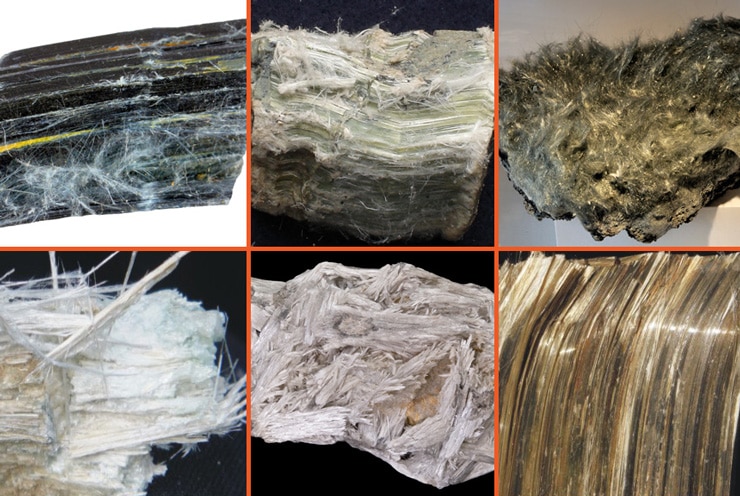
Each asbestos type has a characteristic mineral composition. The following table summarizes the main elements associated with each variety.
| Asbestos type | Main chemical components | Common name or description |
| Chrysotile | Magnesium, silicon, oxygen, hydrogen | White asbestos |
| Amosite | Iron, magnesium, silicon, oxygen, hydrogen | Brown asbestos |
| Crocidolite | Sodium, iron, silicon, oxygen, hydrogen | Blue asbestos |
| Tremolite | Calcium, magnesium, iron, silicon, oxygen, hydrogen | Often white or gray-green |
| Actinolite | Calcium, magnesium, iron, silicon, oxygen, hydrogen | Often green or gray-green |
| Anthophyllite | Magnesium, iron, silicon, oxygen, hydrogen | Often gray or brownish |
These are general descriptions rather than definitive identification standards. Mineral composition can vary, and different asbestos types may have similar colors or appearances.
Chrysotile: A Magnesium-Rich Silicate
Chrysotile contains magnesium, silicon, oxygen, and hydrogen in a layered mineral structure. Its fine, flexible fibers made it suitable for spinning, reinforcement, and incorporation into cement and friction products.
Amosite: An Iron-Rich Mineral
Amosite is the commercial name for the asbestiform variety of grunerite. Its composition includes iron and magnesium within a silicate structure.
Manufacturers historically used amosite in thermal insulation, insulating boards, and selected building products. Its fibers tend to be relatively straight and rigid.
Crocidolite: A Sodium- and Iron-Rich Mineral
Crocidolite is the asbestiform variety of riebeckite. It contains sodium and iron alongside silicon, oxygen, and hydroxyl groups.
Often called blue asbestos, it was used in certain industrial and insulation products. Its fine fibers and resistance to biological breakdown contribute to its serious health concerns.
Tremolite, Actinolite, and Anthophyllite
These three varieties occur in natural geological formations and may also be present as contaminants in certain mineral products.
- Tremolite: Contains calcium and magnesium, with iron varying in amount.
- Actinolite: Contains calcium, magnesium, and iron in varying proportions.
- Anthophyllite: Primarily contains magnesium and iron.
Their presence in a building material cannot be established reliably by color, texture, or visual inspection. Appropriate laboratory analysis is needed when identification matters for safety.
Why Is Asbestos So Strong and Heat Resistant?
The usefulness of asbestos comes from its mineral structure rather than from one particular chemical element.
Its long, thin fibers can reinforce other materials, while the minerals themselves possess properties that made them attractive for demanding industrial applications.
Important Physical Properties
Heat resistance: Asbestos does not burn readily under ordinary fire conditions, which made it attractive for fire-resistant and high-temperature applications.
Tensile strength: Its fibers can help reinforce products and resist pulling forces.
Chemical resistance: Many asbestos minerals resist degradation by a range of chemicals.
Thermal insulation: The fibrous structure helps limit heat transfer when incorporated into suitable insulation products.
Flexibility: Chrysotile fibers can bend and form flexible bundles, making them useful in selected manufacturing processes.
These properties helped asbestos become common in older buildings, factories, boilers, pipelines, and industrial equipment.
However, a material’s usefulness does not determine its safety. The same microscopic fibers that made asbestos valuable for reinforcement can create a serious inhalation hazard when released into the air.
Why Fiber Size Matters
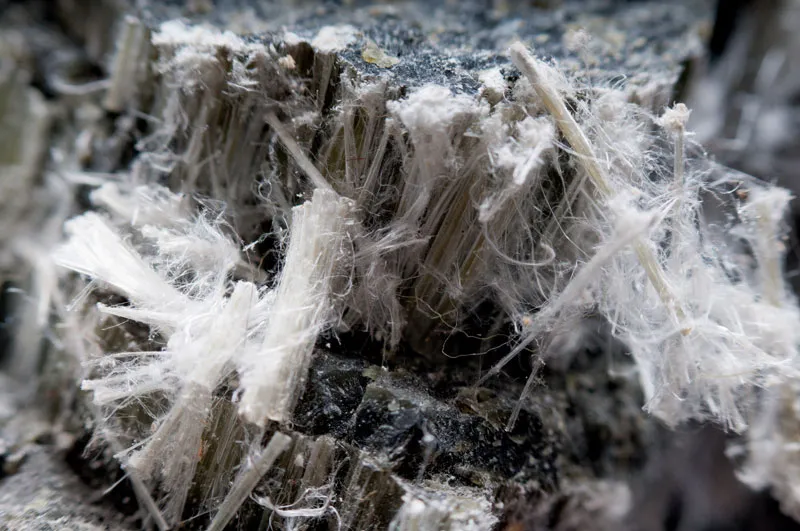
Asbestos fibers and finer fibrils can be too small to identify reliably with the naked eye. Cutting, sanding, drilling, breaking, or deteriorating asbestos-containing materials can release fibers into the surrounding environment.
The risk depends on several factors, including the material’s condition, the activity being performed, and the amount of airborne fiber generated.
For example, an intact asbestos-cement panel may release fewer fibers under undisturbed conditions than a damaged panel being cut with power tools. This does not mean the intact panel is automatically risk-free; it means exposure potential depends partly on how the material is managed.
Which Building Materials May Contain Asbestos?
Asbestos was incorporated into many construction products because it offered strength, insulation, and resistance to heat. Its presence depends on the product’s age, manufacturer, location, and original formulation.
Asbestos-Cement Roofing and Wall Panels
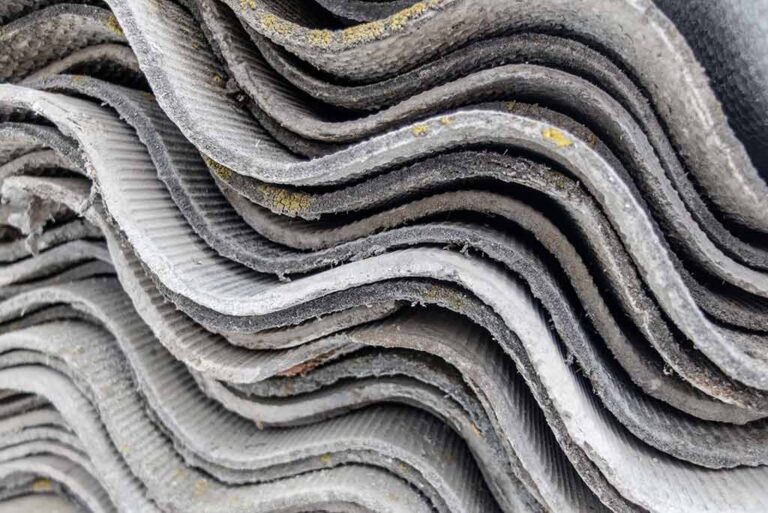
Some historical roofing sheets, wall panels, pipes, and other cement products contain asbestos fibers embedded within a cement matrix.
These products were widely used in construction because asbestos helped reinforce the cement. Weathering, damage, or inappropriate cutting can increase the potential for fiber release.
Pipe and Boiler Insulation
Older industrial facilities, heating systems, boilers, and steam pipelines may contain asbestos insulation.
Such materials require particular care during maintenance because insulation can become damaged when workers remove coverings, repair pipework, or access equipment.
Floor Tiles and Adhesives
Some older vinyl floor tiles, sheet flooring backings, and flooring adhesives contained asbestos.
Appearance alone cannot confirm whether a particular floor covering contains asbestos. Removing old flooring without checking for suspected hazardous materials can create unnecessary exposure.
Ceiling Textures and Wall Compounds
Some historical textured ceiling coatings, insulating boards, plaster products, and joint compounds contained asbestos.
Not every textured ceiling or older wall finish contains asbestos. When the material’s composition is uncertain, professional assessment is more reliable than visual guessing.
Other Historical Applications
Asbestos was also used in certain brake linings, industrial gaskets, fire-resistant textiles, and other specialized products.
For building managers, the practical lesson is to evaluate the specific material rather than assuming that every older product contains asbestos or that a familiar-looking product is automatically safe.
Is Asbestos the Same as Dust, Lint, or Fiberglass?
No. These materials differ in origin, composition, and potential hazards.
- Asbestos refers to six naturally occurring fibrous silicate minerals.
- Asbestos fibers are the microscopic mineral fibers that may be released from asbestos-containing materials.
- Household dust is a mixture of particles from sources such as soil, skin, fabrics, and building materials.
- Lint consists mainly of fibers shed from textiles, clothing, carpets, and similar materials.
- Fiberglass consists of manufactured glass fibers rather than naturally occurring asbestos minerals.
Dust and lint may accumulate in buildings where asbestos-containing materials are also present. However, ordinary dust or lint does not prove asbestos contamination.
The term Asbestlint, when used descriptively, can refer to discussions about lint, dust, fibers, and possible asbestos concerns. It is not a standardized mineral classification or a recognized medical diagnosis.
For example, dust near deteriorating insulation in an older industrial building may justify further investigation. A pile of ordinary laundry lint, by contrast, is not evidence that asbestos is present.
The key point: You cannot confirm or rule out asbestos by examining dust or lint with the naked eye. Suspected asbestos-containing materials require appropriate professional assessment and, when warranted, laboratory analysis.
Why Is Asbestos Dangerous to Human Health?
The main health concern associated with asbestos is inhalation of airborne fibers.
When a person inhales asbestos fibers, some may become lodged in lung tissue or the lining surrounding the lungs. The resulting damage can develop slowly, and asbestos-related diseases may take decades to appear.
Recognized diseases include:
- Asbestosis: Scarring of lung tissue that can cause breathing difficulties.
- Lung cancer: A malignant disease associated with asbestos exposure.
- Mesothelioma: A cancer affecting the lining of the lungs or other organs.
- Laryngeal and ovarian cancers: Also associated with asbestos exposure.
The level of risk depends on factors such as cumulative exposure, the characteristics of the fibers, and individual circumstances. Smoking combined with asbestos exposure substantially increases lung cancer risk.
The World Health Organization and the International Agency for Research on Cancer recognize asbestos as carcinogenic to humans. No asbestos type should be treated as harmless simply because its composition differs from another variety.
Does the Type of Asbestos Determine Its Risk?
Mineral composition and fiber structure influence how asbestos behaves in the body, but neither provides a simple measure of an individual’s risk.
Amphibole fibers generally persist longer in biological tissues than chrysotile fibers. Nevertheless, chrysotile is also carcinogenic.
Exposure conditions matter considerably. The amount of fiber released, airborne concentration, duration of exposure, and effectiveness of protective measures all affect the potential for harm.
For homeowners, contractors, and facility managers, preventing unnecessary exposure is more important than attempting to determine safety from a mineral’s color or commercial name.
How Can Asbestos Be Identified Safely?
Asbestos cannot be reliably identified by sight alone because its fibers may be mixed into cement, plaster, insulation, flooring, and other products.
If you suspect that a building material contains asbestos, follow these precautions:
- Avoid disturbing it. Do not drill, cut, sand, scrape, or break the material to investigate its composition.
- Check its condition from a safe distance. Look for visible deterioration without touching or collecting loose material.
- Review building records. Construction dates, product documentation, and previous survey reports may help establish whether further assessment is needed.
- Seek professional advice. A qualified asbestos surveyor or appropriately trained specialist can assess the material and determine whether sampling is necessary.
- Use suitable laboratory analysis. Laboratories can apply validated methods, such as polarized light microscopy or other appropriate analytical techniques, to identify asbestos in bulk samples.
If suspected asbestos-containing material is damaged, restrict access to the affected area and seek professional guidance. Avoid sweeping, vacuuming with ordinary equipment, or collecting samples yourself.
The appropriate response depends on the material, its condition, local regulations, and the likelihood of exposure.
For further guidance, consult the UK government’s asbestos information.
Conclusion
Asbestos is made of naturally occurring silicate minerals containing silicon, oxygen, and varying amounts of magnesium, iron, calcium, and sodium. Its six recognized types belong to the serpentine and amphibole groups, which differ in their crystal structures and fiber characteristics.
These properties made asbestos useful in construction, insulation, cement products, and industrial equipment. However, inhaling airborne asbestos fibers can cause serious diseases, making careful material assessment and exposure prevention essential.
For property owners and maintenance professionals, the most reliable approach is to avoid disturbing suspicious materials, arrange appropriate professional assessment, and use qualified laboratory testing when needed. Understanding the composition of asbestos is a useful first step, but safe decisions depend on identifying the actual material and evaluating its condition.
Have you encountered an older building material that you suspect may contain asbestos, and what would help you determine the safest next step?
Frequently Asked Questions
1. What is asbestos made of?
It consists of silicate minerals containing silicon, oxygen, and metals such as magnesium and iron.
2. Is asbestos a natural mineral?
Yes. Asbestos forms naturally through geological processes.
3. Does asbestos contain iron?
Yes, some types contain substantial iron, while chrysotile is primarily magnesium-rich.
4. What are the six types of asbestos?
Chrysotile, amosite, crocidolite, tremolite, actinolite, and anthophyllite.
5. Is asbestos the same as fiberglass?
No. Asbestos is a natural mineral; fiberglass is made from manufactured glass fibers.
6. Can you identify asbestos by color?
No. Visual appearance cannot reliably confirm or exclude asbestos.
7. Does all old insulation contain asbestos?
No. Some older insulation contains asbestos, but many products do not.
8. Is chrysotile asbestos safe?
No. Chrysotile is carcinogenic and should not be considered safe to inhale.
9. Can you see asbestos fibers?
Individual fibers generally cannot be reliably identified with the naked eye.
10. What should you do if you suspect asbestos?
Avoid disturbing the material and consult a qualified asbestos professional.