
The conversation around office design has shifted irreversibly. For most of the last century, office interiors were an afterthought — functional spaces provisioned by facilities teams with modest budgets, tasked primarily with fitting as many desks as possible within a given floor plate.
That model is effectively obsolete. In the post-pandemic labour market, where knowledge workers have experienced both the autonomy of remote work and the isolation that often accompanies it, the physical workspace has become a competitive differentiator. Companies in Delhi NCR that invest thoughtfully in their office environments are reporting measurable advantages in recruitment, retention, and — critically — collaboration quality.
What Has Changed, and Why It Matters in India Specifically
India’s commercial real estate market is going through a generational upgrade in quality. New Grade-A buildings in Gurgaon, Noida, and South Delhi are delivering bare-shell floor plates that are architecturally excellent — high ceilings, abundant natural light, efficient column grids. What happens inside those shells is now entirely down to the tenant.
This creates both an opportunity and a risk. The opportunity: for the first time, a mid-size Indian company can create a genuinely world-class workspace without a multinational’s budget, because the building fabric is doing more of the heavy lifting. The risk: without expert design guidance, companies end up with expensive fit-outs that look impressive in photographs but fail to function well as daily work environments.
The Functional Hierarchy of Good Office Design
Before aesthetics, good office design must get the functional hierarchy right:
- Focus work — Do you have enough private or semi-private spaces for deep, uninterrupted work? Open-plan offices without acoustic shelter reliably damage individual productivity.
- Collaboration — Are your meeting rooms the right sizes for how your teams actually use them? Most companies over-provision formal boardrooms and under-provision 4–6 person rooms for working sessions.
- Informal interaction — The serendipitous conversations that happen at coffee points, near staircases, or in casual lounge areas are disproportionately valuable for organisational knowledge transfer. Are they designed in, or left to chance?
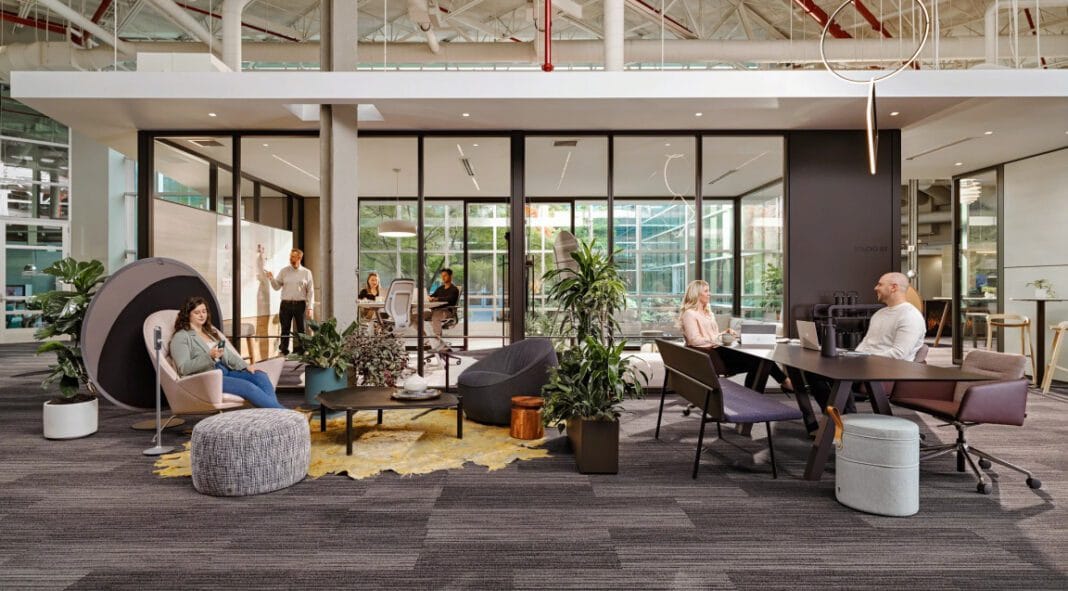
- Wellness infrastructure — Natural light penetration, air quality, greenery, acoustic treatment, and ergonomic furniture are not luxury items; they directly affect how long people can work effectively.
An experienced commercial interior designer will audit how your specific teams work before drawing a single line — because the right layout for a legal firm is fundamentally different from the right layout for a product engineering team.
The Delhi NCR Design Sensibility
Office design in Delhi NCR has developed a distinctive character that reflects both the aspirations of the city’s business community and its cultural richness. The best projects in the market tend to blend:
- Contemporary global aesthetics — clean lines, high-quality materials, restraint in decoration — with locally sourced accents: handcrafted furniture, artisan wall treatments, or bespoke joinery that references Indian craft traditions.
- Climate-responsive thinking — Delhi’s extreme summer temperatures mean that internal thermal comfort and the transition between air-conditioned and non-air-conditioned zones requires careful design attention.
- Biophilic elements — Living walls, indoor plants, and natural material palettes have become standard practice in premium fit-outs, responding to research that consistently links natural elements in the workspace to reduced stress and improved cognitive function.
Working with a specialist in office interior design in Delhi means accessing teams who understand these contextual factors — not just international design trends, but the specific requirements of the NCR market, its vendors, its construction supply chain, and its regulatory environment.
The Project Management Problem (and How to Solve It)
Design is only half the challenge. The other half is delivery. Delhi NCR’s fit-out market is deep in terms of vendor availability but highly variable in quality. The gap between a well-designed space and a well-executed space is almost entirely a project management problem.
Common fit-out failures in the NCR market:
- Scope creep driven by value engineering — contractors substitute specified materials for cheaper alternatives mid-project, degrading the end result without reducing cost.
- MEP coordination failures — electrical, HVAC, and data infrastructure poorly coordinated with the architectural design, resulting in exposed conduits, insufficient socket points, or HVAC that doesn’t serve the layout as designed.
- Timeline slippage — most commercial fit-out projects in India run 20–30% over planned timelines without robust project management. For businesses paying rent on a vacant space, this is a direct financial cost.
End-to-end project management and interior fit-out services that own both the design and the delivery provide a single point of accountability — and typically deliver better outcomes than the more fragmented model of hiring a designer and then tendering separately to contractors.
Budgeting for a Fit-Out: What Realistic Numbers Look Like
Fit-out cost benchmarks in Delhi NCR vary by specification tier:
- Basic/functional: ₹1,200–1,800 per sq ft. Practical, clean, with standard materials. Suitable for back-office or operational spaces.
- Mid-range: ₹1,800–2,800 per sq ft. Good quality finishes, proper acoustic treatment, branded reception. Appropriate for most professional services firms.
- Premium: ₹2,800–4,500+ per sq ft. High-specification materials, custom joinery, advanced AV/tech integration, biophilic elements. Suited to headquarters spaces and senior leadership environments.
These are all-inclusive fit-out costs covering civil, MEP, furniture, and soft furnishings. Technology infrastructure (structured cabling, AV systems, access control) is typically budgeted separately.
The ROI Framing Your Finance Team Will Appreciate
The single most useful reframe for companies reluctant to invest in their workspaces: the annual cost of a well-designed fit-out, amortised over a 5-year lease, is typically ₹150–400 per sq ft per year. For a 100-person office, that’s ₹15–40 per employee per day — a fraction of what those employees cost in salaries, and a fraction of what replacing a disengaged or departed employee costs in recruitment and onboarding.
The workplace is infrastructure. Treat it accordingly